
It was their first holiday since Rebecca, their daughter, had gone abroad and they’d both overpacked.
“It’s like we’re moving house,” he’d said, yesterday, loading suitcases into the boot. There were three in total: one his, one hers, one shared.
Now he was in his Barbour jacket at the foot of the stairs and holding the car keys. “Come on Alice,” he said, “It’s already half past.”
She called back “two minutes” and when she came down, had a stack of four books to replace the one she’d been looking for.
“Do you need so many?”
“Do you need to be so pushy?”
He watched her tie her shoes and adjust the laces so both loops were evenly sized.
“If I wasn’t pushy, nothing would get done.”
In the car, there was a familiar musty smell: a smell that reminded him of long journeys to France and that rusty stale feeling in his legs. Despite the cold, he rolled down his window to let some air in and then peered round, through the back window at the road behind.
They’d built a new wall to replace the old, wooden one at the front of the house. It was red brick and rather splendid. A wall to be proud of. But it was too narrow. Pulling out was a ritual struggle.
“You’re fine, you’re fine,” she said as he inched back, but then he stopped and the car jolted forward.
“You’ve got space,” she said.
“I don’t. I’m going to hit it.”
“For god’s sake.”
“I don’t understand how you manage to park so close to the left,” he said, “How am I supposed to get out.”
“Well, you park too close to the right for me.”
He drove forward to make a wider angle.
“It’s because you’re left-handed,” she said.
On route, the sky was grey and matched the road ahead. There was a steady groan coming from somewhere in the bonnet like an animal was dying rather tunelessly inside. She had one leg over the other, a book rested on her thigh and she was making quick notes with a pencil. He considered switching on the radio. He knew, if he asked, she’d say it was fine – insisting, because he was the one driving. But he didn’t want to disturb her. Or, more precisely, he didn’t want to be blamed for disturbing her, if only privately.
“What would you like to do when we’re there?” he said, a little too loudly.
She turned as though surprised to find him there. “I don’t know.” She tucked her thumb to hold her place. “What’s there to do in Cromer?”
“A walk on the beach?”
“It’s going to be cold,” she said, factually.
“Or something else then.”
“No, the beach is fine.” She folded the corner of her page and closed the book, then rested her head against the window.
“Are you excited?” he said.
“Excited for what?”
“For the holiday.”
“Oh, yes, of course. Sorry, I didn’t know what you meant.”
He made a noise that was somewhere between laugh and sigh. “What a great start.”
“I didn’t know what you meant.”
The place was a small bungalow recommended by his sister Nina. He didn’t know what to expect as the pictures on the website were from 2009, but he was surprised by how modern it looked inside, with an open plan living and dining room and shiny, new cupboards. They had a mechanism that stopped them slamming shut. It didn’t feel like Cromer. It felt slick and unhomely.
The drive had taken longer than expected and by the time they’d carried the bags indoors, it was already half-four and starting to get dark.
“Why don’t we just go now,” she said when he started hanging clothes in the wardrobe. “We’re going to lose the light.”
“Can we unpack first?” he said, “we’ll feel more settled.”
“But we’ll miss the sunset.”
“No, we won’t.”
“We don’t even know how to get to the beach.”
“It’s fine. I’ve been here before.”
“When you were twelve.”
He turned and looked at her, holding two pairs of folded underpants. “It will take fifteen minutes.”
She shook her head. “I’ll go on my own.”
“Okay, okay,” he said and followed her into the hall.
While she waited outside, he dropped his walking shoes from standing height in a secret show of dissent and they thudded against the floor, bounced, and rolled over. When he closed and locked the door, however, and they looked at each other, both enveloped in hats and scarves, neither of them could help smiling. They tried to interlace their fingers, but their gloves were too bulky, so they held each other palm to palm.
“Do you know the way?” she said.
“It should be straightforward. We just need to follow the natural decline.”
After fifteen minutes, they wound up in the car park of a large shop. Inside, the lights were off and a man in blue uniform stared blankly at them through the window.
“I’ll check my phone,” she said.
“I think it must be through here. Look there’s a gate.”
“We have to go back round.”
“Are you sure?” he said.
“Trust the phone, Rich.”
“Well, the phone doesn’t know everything. I could have sworn it was through there.”
“It’s not.”
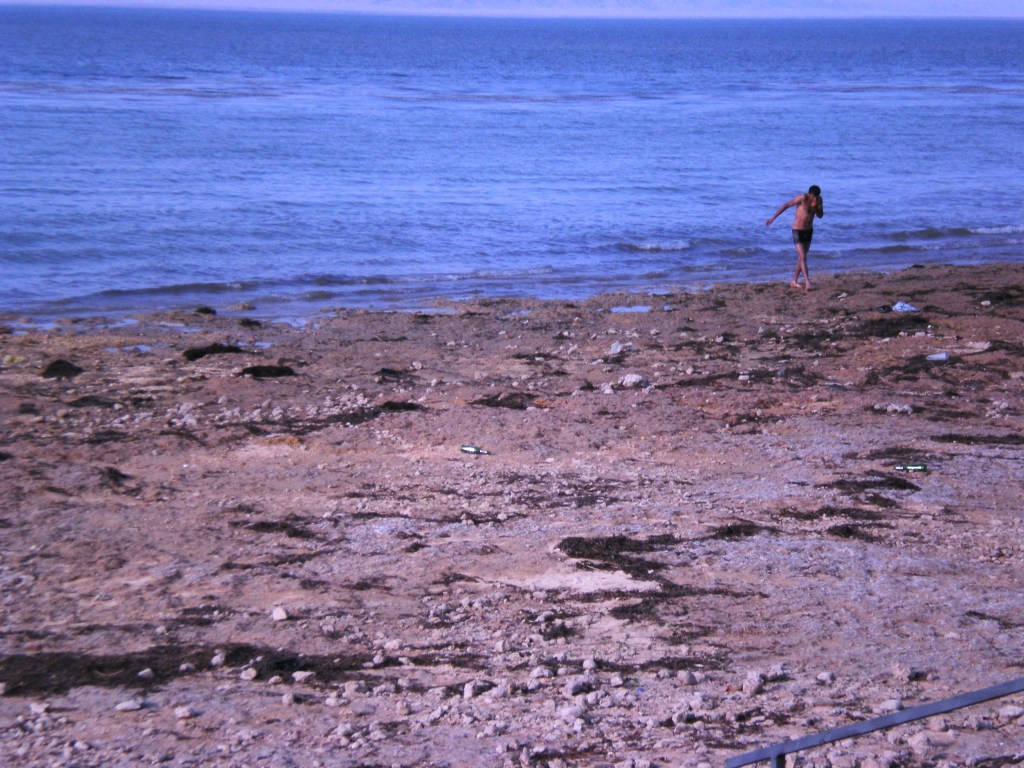
When they arrived, apart from a dog walker in the distance, the beach was empty and the sand grey and hard. It barely registered their footsteps. The sky was overcast, with the sun setting behind them, away from the sea, but the clouds were beautiful nonetheless, illuminated a vague pink that slipped into navy as they walked. The light was soft and made her skin paler and her features delicate. He squeezed her hand and she did the same.
“It’s lovely, isn’t it,” she said.
“It really is.”
After twenty minutes, the sun was just a lip of blue above the town behind them.
“We should go back soon,” he said, forgetting how dark it got outside the city.
“Yeah,” she said, but then he felt a resistance pulling his arm back and realized she’d stopped.
“Alice?” he said a pace ahead. She was turned away as though bracing herself against the cold. It took a moment to register her crying over the wind.
“What’s wrong?”
“I don’t know,” she said. “Can we sit? I think I need to sit.”
He eyed the sand below, wet from where the tide had been. “Of course.”
She lowered herself, one hand covering her face, and he tried to squat beside her but didn’t have the balance and tipped forward onto his knees. She wiped her nose with the sleeve of her jacket, and he saw that her eyes were blotchy.
“What’s wrong?”
She opened her mouth to say something but then closed it again and looked over at the sea as though expecting to find something there. When she spoke, her voice was thin: “I’m not sure. I don’t think it’s anything.”
She rubbed the inside of her eye with a gloved finger, “I’m sorry.”
“It wasn’t anything I said, was it?”
“No, not at all.”
“You can say if it was.”
“It wasn’t.”
She brushed sand from the glove that had been on the ground. “I’m fine.”
When they got back, he gave her a rug to drape over her legs and put the kettle on, but then remembered they hadn’t brought teabags, and so made two cups of boiled water.
“Seven,” he said, looking at his watch. “I wonder if Rebecca’s up yet. It would be, what, eight in the morning over there?” He drummed the back of the sofa
with his hands. “Are you hungry? Or would you like me to put the TV on?” He picked up the remote and began jamming it with his thumb.
“No, Rich, I’m fine.”
After a second, BBC news flashed up and he turned it off again.
“Maybe I’ll unpack,” he said but found he couldn’t move. He opened his mouth with the intention to say something.
“Don’t you feel it?” she said, interrupting his silence.
“Feel what?”
She sighed, “surely you must feel it.”
“What’s it?”
Her face was unexpected, almost pleading, and he had to look away. He walked over to the kitchen and picked up a glass from the side. The fridge had one of those ice cube dispensers and he watched a few of them drop into his glass.
“What’s to be done?” —it was a meaningless thing he said sometimes, and she didn’t reply.
He looked at the cupboard beneath the sink and thought, casually, about putting his foot through it. Instead, he put his glass down on the side.
“Alice?” he said. “I’m trying.”
“I know, I know.”
“Do you though? Sometimes, I’m not so sure. You sit there…” he gestured with both hands. “… and I was the one who said that we should do something together, I was the one who found the place, who booked everything, who drove us down …”
“You’re blaming me?” she said. “That’s really great.”
“No. I just don’t like feeling as though I’m some oppressive force in your life. It would be nice if you put in some effort instead of just complaining.”
“I wasn’t complaining, Richard, I was upset. There’s a difference, and you acting like this doesn’t exactly help.”
He didn’t say anything and opened the fridge behind him. It was empty, apart from a plastic water bottle that had been left. He closed it again and stood over the kitchen side, both hands flat against the surface. Then he brought his left arm up and swung it down. He’d intended to make contact with his palm, but most of the impact landed on the tips of his fingers and made a dull slap. A numbing pain erupted.
“Fucking hell.”
He turned to see her shake her head and said pointedly, “what?”
“Honestly,” she said, “can’t we just have a normal conversation. I was upset.”
“And maybe I’m upset.”
“Why do you have to be so aggressive?”
“I’m not being aggressive. I’m trying to explain how I feel.”
She put her mug down on the floor to avoid spilling it. “Well do you realize how it affects other people? It’s selfish. I don’t act like that.”
“No, of course not. You’d never do that. You’d never actually take a stance on anything. It’s easier to sit there feeling sorry for yourself.”
“You’re unbelievable,” she said standing up. “Honestly. I don’t know what I’m doing here.”
“I’m not forcing you to stay.”
She folded the rug and placed it beside her on the sofa. “It’s always the same,” she said and walked into the bedroom.
After a while, he thought about opening the bottle of Merlot they’d brought, but remembered it was in the suitcase by the bed. Instead, he sat on one of the hard chairs around the dining table and waited for his body to tire out on its own.
But something was nagging at him.
It wasn’t even the argument, necessarily. There were always arguments and there were always reconciliations. It was very rare that one would spill over into the next day. Mornings were a time of forgiveness.
No, it was something else, something she’d said.
“Surely you must feel it.”
It.
What could it possibly mean? It was so ridiculously vague that he felt a rush of injustice at having to do this kind of detective work.
Directness – that’s what he wanted.
At least, that’s what he said he wanted.
But then again, considering it now, he wasn’t so sure.
Recently he’d started to question whether he was even particularly direct himself. It wasn’t always possible, after all.
Directness, honesty, truth.
They sounded good on paper. But with some things, the more you tried to grasp them, the further you pushed them away.
He stretched his hand across the table. It was solid wood, varnished and, in this light, almost black. On it, there was a stain. Perhaps some tomato sauce that hadn’t been wiped off and had crusted over. He scratched at it with his nail, producing a little pile of red dust.
It was funny to think of other people in this space.
And he remembered, for no particular reason, the family he’d been next to on the train yesterday, commuting back from work. There must have been six children and four adults in total. The boys, probably between the ages of four and eight all had short hair glistening with gel. And the noise. He didn’t know how they could stand the noise. The parents, talking to one another, had to shout just to be heard.
Rebecca had never been like that. She’d been so polite. Beyond her years in a way. When they’d met up with his sister’s children, he’d always sensed how out of place she’d been—as though, really, she belonged with the adults.
Rebecca. Nineteen. On the other side of the world.
She would be working in the hospital right now. That was a funny thought: her in her scrubs. He should call her and see how she was doing. He hoped she was wearing sunscreen. He hoped she was making friends.
He walked to the bathroom and brushed his teeth using the little tube of complementary toothpaste. In the bedroom, Alice was rolled over, on the left side—her side. He tried to undress as quietly as possible, but as he pulled the trousers over his foot, his belt clinked, and she turned towards him.
“Was I asleep?” she said.
“Yes. Sorry.”
When he slipped under the covers, he put his hand on her shoulder and with her eyes half-shut, she kissed his face, making contact with the tip of his nose.
Then she turned so her back was to him and they were both facing the wall.
There was a map of Cromer on that wall.
He couldn’t see it in the dark, but he knew it was there. It was the first thing he’d noticed when he came in. The slab of blue designating the sea. The wiggly roads beside it, all jumbled together like string.
reconciliations
-
reconciliations
After twenty minutes, the sun was just a lip of blue above the town behind them. “We should go back soon,” he said, forgetting how dark it got outside the city. “Yeah,” she said, but then he felt a resistance pulling his arm back and realized she’d stopped. “Alice?” he said a pace ahead.
-
the day her father died
I didn’t know Sarah’s dad particularly well. He was shy and religious. Sarah told me he found my presence difficult – she was the oldest and I was the first boyfriend in the family.
-
that funny place
Where trees go to bow their leaves and offer them to rainy streets. where sunshine scatters like loose change and kisses fall like petals. I only wish I could see you again, not because I forget— I see you too clearly if anything, Piecing you together each day. There’s your nose, opposite, on the tube,…
-
Free range pigs
life isn’t always sweet for the free range pigs
Comments (
0
 Seaguls in mud
Leave a comment